
Portion control and food cost: why consistency matters
Inconsistent portioning is one of the most common and invisible drivers of high food cost. Here is how to fix it.
Portion control is the discipline of serving the same quantity every time a dish is plated. It sounds obvious. In practice, it is one of the most frequently violated food cost disciplines in kitchens of all sizes.
When a cook plates 175 g of protein instead of 150 g, the food cost on that dish rises by 17% instantly, without any change in purchasing, recipes, or prices. Multiply that across dozens of covers per service and the impact on monthly food cost percentage is significant.
How inconsistent portioning shows up in food cost
Your recipe says 150 g of chicken breast per portion. Your cook typically plates 165 g. That is a 10% over-portion. If chicken breast costs $0.0075/g, the over-portion adds $0.1125 per plate in hidden cost.
At 60 covers per night and 25 service days per month: 60 x 25 x $0.1125 = $168.75 per month in untracked food cost from a single over-portioned ingredient.
Tools for portion control
Common over-portioned items
How to build a portion control culture
First, ensure every recipe spec lists gram or volume quantities, not vague instructions like "a handful" or "a good amount." Recipes with vague quantities cannot be consistently executed.
Second, train staff with a portion audit: cook a dish to spec, weigh every component, show the team what the target looks and weighs like. Repeat with new hires.
Third, spot-check periodically. A manager who occasionally weighs a portioned plate before it goes out sends a signal that accuracy matters.
When not to enforce strict portioning
Some items are low-cost enough that minor variation is immaterial. A garnish of chopped parsley or a slice of lemon does not need gram-level precision. Focus your portion control energy on the highest-cost components: proteins, premium cheeses, specialty sauces, and expensive produce.
Frequently asked questions
Read the transcript
$14 for a 12-inch margherita. Almost none of that is the pizza. And most kitchens are quietly losing the part that is one scoop at a time. So let's go and find it.
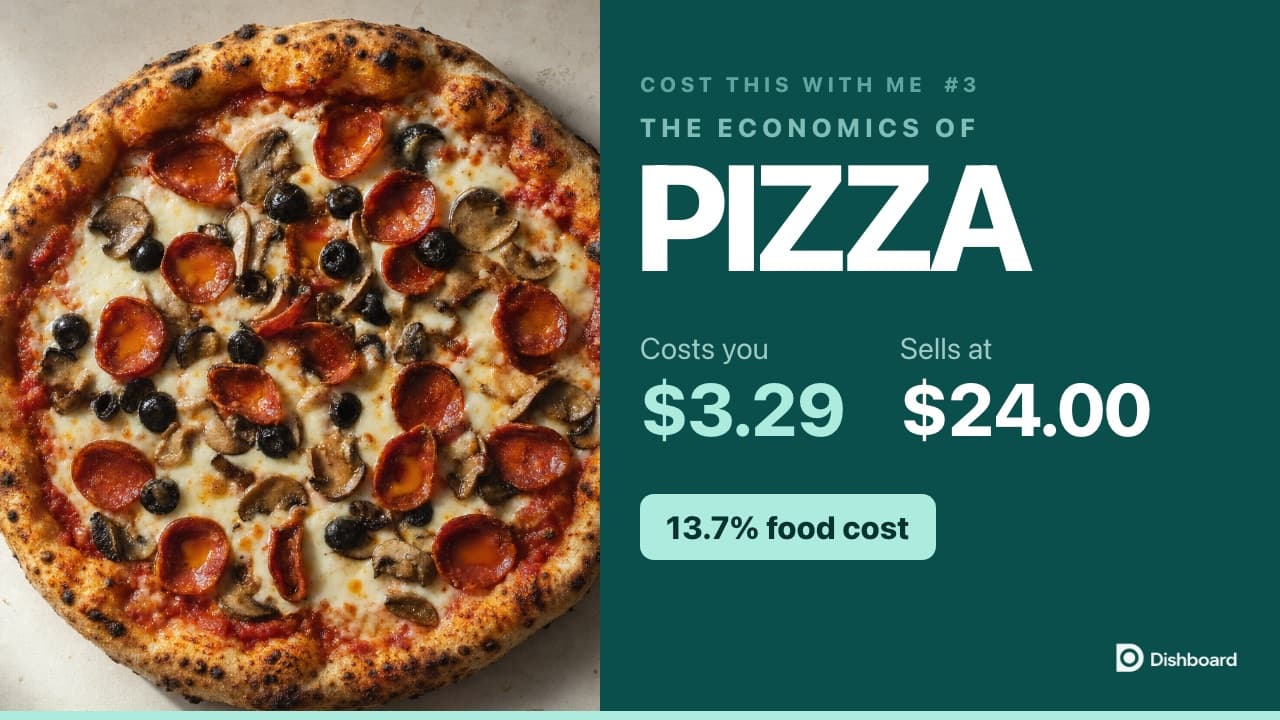
Here is everything on it. A dough ball, $0.20. 90 grams of tomato sauce, $0.36. 130 grams of mozzarella, $1.04. Basil, oil, and semolina to finish, $0.14. $1.74, and nearly all of that is the cheese.
Start with the dough, because that is what everyone blames. You do not buy dough balls. You make a batch. $12 of flour, salt, and yeast, and water that costs nothing. One batch is 60 balls. So the base of the whole pizza is $0.20. It is not the flour.
So blame the toppings. 45 grams of pepperoni, $0.54. 60 grams of mushroom, $0.33. 30 grams of black olives, $0.24. And 55 grams more mozzarella, $0.44. All four add $1.55 of food and $10 to the bill. It is not the toppings either.
So you keep $20.71 on one pizza, which leaves one suspect. The cheese is most of your cost. And it is the only thing on that list nobody puts on a scale. 30 grams extra, one generous hand, is $0.24 a pizza. At 120 pizzas a day, that is $28.80 every day. You are not running a pizzeria. You are running a cheese counter.
Cost yours the same way. It's free. No card. Dishboard.co. And if you want more of these, subscribe.
Cost the dish at the portion you planned, then again at the one that leaves the pass.
Free, and no account needed.
Free tools
Put the math to work in seconds. No signup required.