
How to calculate recipe yield
Yield is the difference between what goes in and what you can actually plate. Two types to track, and how each affects your cost per portion.
Yield is one of the most overlooked factors in menu costing. When you buy a whole chicken, peel onions, or cook down a sauce, you lose mass. If you cost a recipe based on raw purchase weight rather than usable weight, you are understating your cost per portion, sometimes by 20% or more.
There are two types of yield to track: trim yield on raw ingredients, and output yield on prep recipes.
Type 1: trim yield on raw ingredients
Trim yield measures how much of a purchased ingredient is actually usable after prep. Anything discarded (bones, peels, fat trim, unusable stalks) is loss.
The formula: trim yield % = usable weight divided by purchased weight x 100
Example: you buy 1 kg of whole onions for $1.80. After peeling and trimming, you have 750 g usable. Trim yield = 750 divided by 1,000 x 100 = 75%.
To find the true cost per usable gram: $1.80 divided by 750 g = $0.0024/g. If you had divided by 1,000 g (ignoring yield), you would get $0.0018/g, understating cost by 25%.
Common trim yield benchmarks
These are starting points. Measure your own yields with actual product from your suppliers, as quality and trim style vary.
Type 2: output yield on prep recipes
When you cook a sauce, marinate a protein, or make a dough, the prep recipe produces a specific output quantity. Output yield measures how much you get out of a batch.
The formula: cost per unit of output = total input cost divided by output quantity
Example: a house mayo batch costs $1.82 in ingredients and produces 280 g of mayo. Cost per gram = $1.82 divided by 280 = $0.0065/g. If a menu item uses 30 g of mayo, it carries $0.195 in mayo cost.
Why prep recipe yield matters
Sauces, dressings, marinated proteins, and doughs are used across multiple menu items. Getting the cost per unit of output right means every dish using that prep recipe is costed accurately.
If you guess at the output yield, or forget to account for evaporation during cooking, every dish using that prep recipe carries an understated cost.
Cooking loss vs. trim loss
Proteins lose significant weight when cooked. A 200 g raw chicken breast may weigh only 165 g after grilling, an 18% cooking loss. If your recipe specifies 150 g of cooked chicken per portion, the actual raw input needed is 150 divided by 0.82 = 183 g raw.
Always specify whether recipe quantities are pre- or post-cooking, and apply the appropriate yield factor when calculating cost.
Tracking yield in practice
Measure yield when you first recipe-cost a dish, then recheck it periodically. If you switch suppliers or change prep methods, yield may shift. A consistent 5% lower yield on your main protein across 200 portions per week can meaningfully change your food cost.
In Dishboard, you can set a yield percentage on each ingredient. The system automatically adjusts cost per usage unit to reflect the actual usable quantity.
Frequently asked questions
Read the transcript
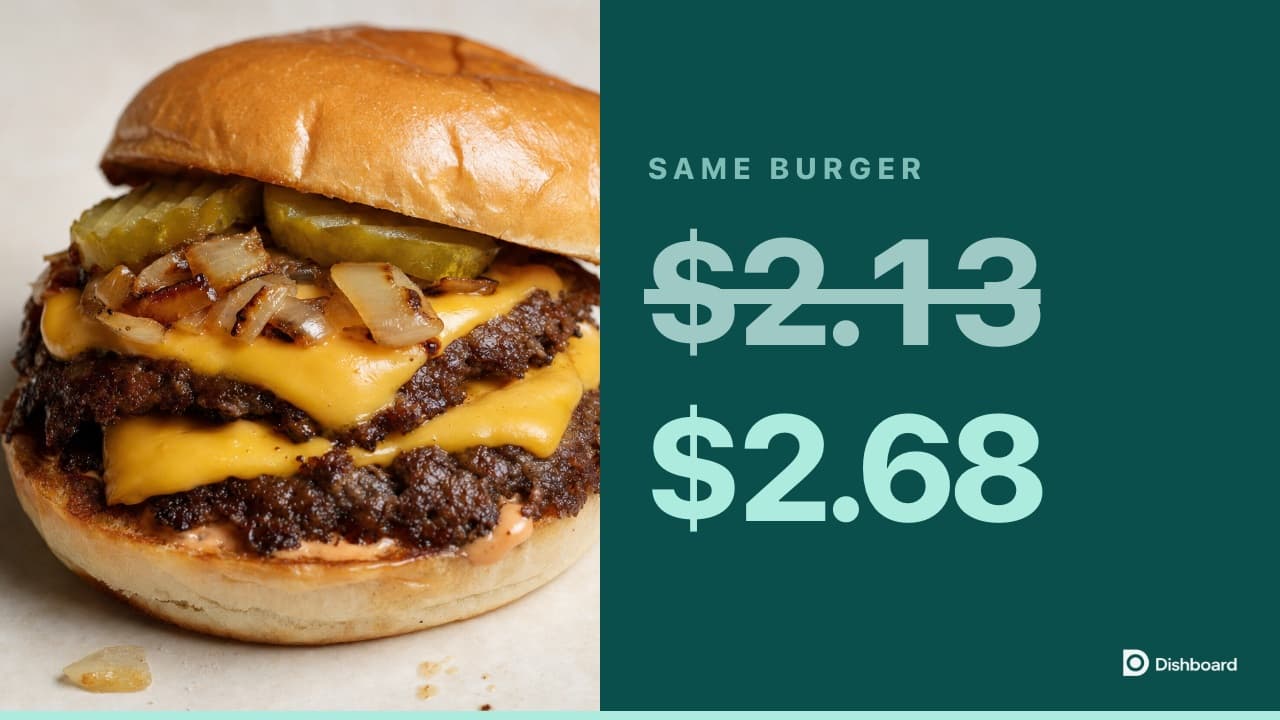
This is a Double Smash burger, $10.50 on the menu. Two kitchens cost it. One says $2.13. The other says $2.68. Same burger, same suppliers, same invoice, $0.55 apart. And the wrong number is the one almost everybody uses. So let's find the $0.55.
Start with the beef, because it is the biggest piece of it. A Double Smash is 160 grams, and beef is $9 a kilo. 160 grams goes on the griddle. 120 comes off it. The rest leaves as water and fat into the air. So when you cost the burger, you cost what is on the bun. 120 grams, $1.08. But you did not buy 120 grams. You bought 160. That is $1.44. 36 cents a burger on the most expensive thing on the plate. Cost what leaves the walk-in, not what lands in front of the customer.
That is not a beef problem. It is the same problem everywhere you trim something. You buy pickles by the jar. Two and a half kilos, $9. That is $3.60 a kilo. And 25 grams on the burger is nine cents. Now drain the jar. A kilo and a half of pickles. The rest is brine, and it goes down the sink. You did not buy two and a half kilos of pickles. You bought a kilo and a half, plus a liter of salt water. So your pickles are not $3.60 a kilo, they are six. Same with the onions. A kilo for $1.80, and 750 grams left once you peel them. You paid for the skins, you just cannot sell them. Anything you peel, trim, drain, or debone needs a yield percentage. And on this burger, that is another nine cents.
Then there is the sauce. Nobody costs burger sauce. It is a squirt. Call it five cents. So let's actually do it. 400 grams of mayonnaise, $1.80. 250 of ketchup, 80 cents. 60 grams of relish, 48. Smoked paprika, 24. Onion powder, 28. $3.60 for the batch. And that batch weighs 720 grams. So the sauce costs $5 a kilo, and the 30 grams on this burger is 15 cents, not five. And this one matters more than it looks, because a prep recipe is not used once. It is used everywhere. Get the output weight wrong, and every dish that touches that sauce is wrong, in the same direction forever. Weigh the batch. Weigh what comes out of it. Divide.
So, the burger. Beef, 160 grams as bought, $1.44. Bun, 40 cents. Cheese, 42. Sauce from the batch, 15. Pickles, drained, 15. Onion, peeled, 12. $2.68. Now, a 25% food cost on a burger is fine. That is not the problem. The problem is that the kitchen using $2.13 thinks it is running at 20, and prices the rest of the menu like a business with more room than it has. 55 cents a burger. At 60 burgers a day, 25 days a month. That is $825. And one last thing, because it undoes all of it. This assumes the cook plates what the recipe says. 15 grams of beef over on every burger is another $200 a month.
So, here's the job for this week. Take your five best sellers. For every sauce or dough on them, weigh the batch, and weigh what comes out of it. Anything you peel, trim, or drain, put a yield percentage on it, and cost your proteins as bought, not as plated. That is most of the gap on most menus. If you want software to do the arithmetic, and keep it right when a supplier price moves, that is what Dishboard does. Free, no card. Dishboard.co. And if this was useful, subscribe.
Cost a recipe as bought rather than as plated, and see the gap for yourself.
Free, and no account needed.
Free tools
Put the math to work in seconds. No signup required.