
How to calculate food cost percentage
The single number every restaurant operator already speaks. Here is how to calculate it cleanly, avoid the common mistakes, and use it to price with intention.
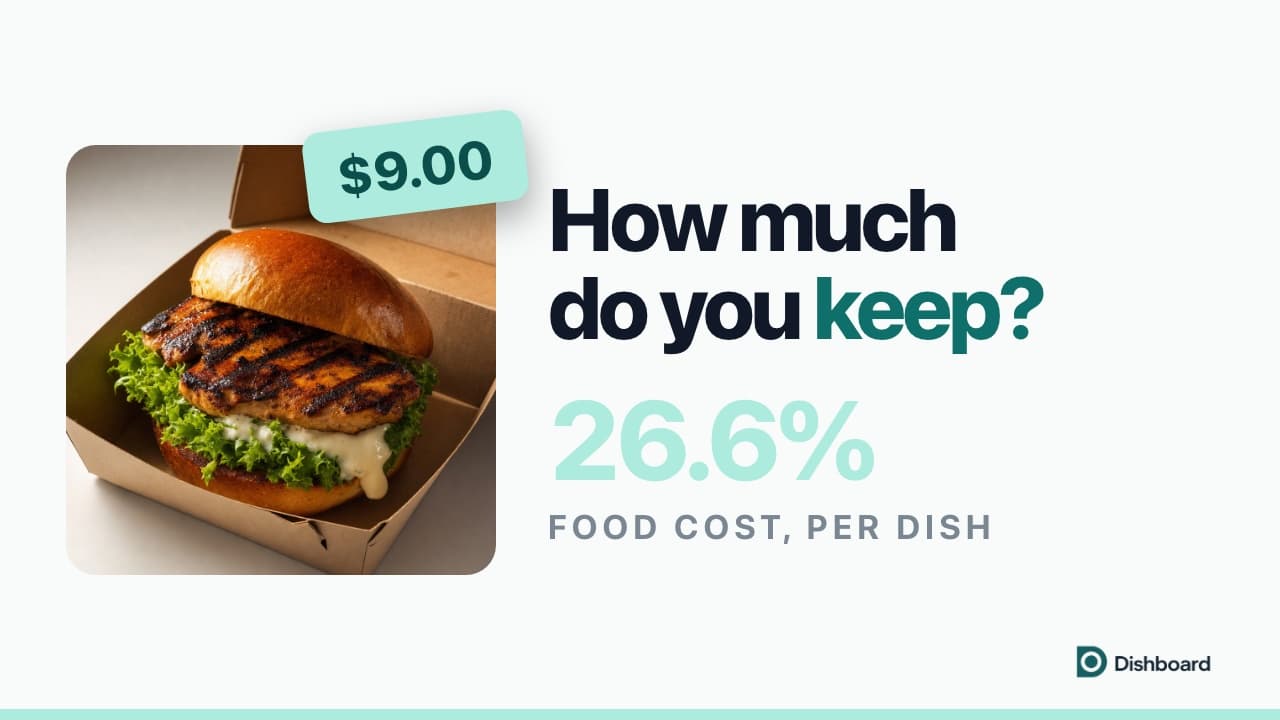
Food cost percentage is the most widely used margin metric in the restaurant industry. It tells you what fraction of a dish's selling price is consumed by the raw ingredients and packaging needed to make it. Once you know this number for every dish on your menu, you can price intentionally, catch margin problems before they hit your bottom line, and make supplier negotiations with real data.
The formula
Food cost % = (cost per portion divided by selling price) x 100
This is simple to state and easy to get wrong, because cost per portion has to be built carefully from the ground up.
How to calculate cost per portion step by step
Cost per portion is the sum of every ingredient, prep recipe component, and packaging item that goes into one serving.
The total is your cost per portion.
A worked example
A chicken sandwich uses: chicken breast 150 g at $0.0075/g ($1.13), bread roll $0.80, lettuce 25 g at $0.0044/g ($0.11), house mayo 30 g at $0.0065/g ($0.20), kraft box ($0.15).
Total cost per portion: $2.39. Selling price: $9.00. Food cost % = $2.39 divided by $9.00 x 100 = 26.6%.
What is a good food cost percentage?
Targets vary by concept, channel, and dish category. Rough US benchmarks:
These are starting points, not rules. Your actual target depends on your labor model, rent, and overall cost structure. A food truck with low overhead can sustain a higher food cost than a full-service restaurant paying high rent and front-of-house staff.
Your goal is not the lowest possible food cost. Some premium items carry a higher food cost percentage and still generate more gross profit per sale than lower-cost dishes. A $30 steak at 38% food cost ($18.60 gross profit) earns more per sale than a $7 salad at 25% food cost ($5.25 gross profit).
How to use food cost % to set prices
Work backwards from your target: suggested price = cost per portion divided by target food cost %.
If your sandwich costs $2.39 and your target food cost is 30%, the suggested price is $2.39 divided by 0.30 = $7.97. That is a floor. If the market supports $9.00, charge $9.00. You are just running a better margin.
What happens to food cost on delivery platforms?
Platform commissions (DoorDash, Uber Eats, Grubhub) do not change your food cost percentage. They reduce what you keep from each sale. A dish with a 30% food cost earns $6.30 gross profit at $9.00 dine-in. On delivery at $9.00 with a 27% commission, the platform takes $2.43, leaving $3.57 gross profit before packaging and fixed fees.
This is why delivery requires a separate profitability calculation on top of food cost. A dish can be on-target for dine-in and underwater on delivery at the same price.
Common mistakes to avoid
Frequently asked questions
Read the transcript
All right, this is a chicken sandwich. You sell it for nine bucks. Quick, how much of that do you actually keep? Most people guess way too high. Let's find out.
Here's what's in it. Chicken, $1.13. The roll, 80 cents. Lettuce, 11. Mayo, 20. And the box, 15 cents. Yep, the box counts. If it leaves your kitchen with the food, you paid for it. Add it up. $2.39.
So, $9 in. $2.39 of that is food. Divide one by the other, times 100, and there it is. 26.6 percent. That's your food cost. And everything left over, 73.4 percent. That's your gross margin. Same story, told two ways.
Is 26 good? Depends what you run. Full service usually lands between 28 and 34. Quick service, 25 to 32. Cafes sit lower, around 22 to 30, because drinks are cheap to make. Bakeries, 28 to 35. So, yeah, 26 is healthy. But treat these as starting points, not rules.
Here's the thing, though. Lower isn't always better. A $30 steak at 38 percent food cost puts 18.60 in your pocket. A $7 salad at 25 percent gives you $5.25. The steak looks worse on paper and makes you three times the money. Percentages don't pay rent.
Three quick things people get wrong. One. Using what you paid for the whole bag instead of what you actually used. A 5-pound bag of flour is $4.50. Use 200 grams? That's 40 cents. Two. Forgetting packaging. A 16-ounce cup is 16 cents. 200 drinks a day, and that's $960 a month just gone. Three. Working it out once and never again. Prices move. Yours should, too.
One more, and this one stings a bit. Delivery doesn't change your food cost. It changes what you keep. Same sandwich, still $9. Dine-in, you keep $6.61. On delivery, at 27 percent commission, you're down to $4.18. Same dish. A third of your profit, gone.
That's one dish. Worked out by hand. Here's Dishboard doing it for you. Add your ingredients once, drop them into a dish, and it works out the cost per serving, your food cost percentage, and your margin as you go. Change a price or a quantity, and every number moves with it. It's free, there's no card, and the link is below.
Put in what a dish costs you and what you charge for it, and see where you land.
Free, and no account needed.
Free tools
Put the math to work in seconds. No signup required.