
Food cost percentage for cafes: targets, benchmarks, and tips
Cafes have a different cost structure than restaurants. Here are realistic food cost targets for cafe menus and how to calculate your blended rate.
A cafe has a fundamentally different cost structure than a full-service restaurant. Beverages, especially espresso-based drinks, carry low food cost and high gross profit. Food items like sandwiches and pastries carry higher food cost. The blended rate across everything you sell determines your profitability.
Understanding this distinction is critical. A cafe that prices its food menu using the same targets as a restaurant may underprice beverages or over-engineer food margins unnecessarily.
Beverage cost benchmarks
Food cost benchmarks
What blended food cost looks like
A typical well-run cafe might sell 70% beverages and 30% food by revenue. If beverages average 20% food cost and food items average 32%, the blended food cost is roughly (0.70 x 20%) + (0.30 x 32%) = 23.6%. That is a healthy overall margin.
If your cafe is primarily food-focused (brunch, all-day dining) with fewer beverages, your blended food cost will be closer to the food-only range.
How to calculate your cafe's blended food cost
Take your total food and beverage cost for a period (from your cost of goods sold in your books) and divide by total revenue for the same period. Multiply by 100. This is your actual blended food cost percentage.
Compare this to a target based on your concept and revenue mix. If actual exceeds target by more than 3 percentage points consistently, investigate the highest-cost categories first.
The oat milk problem
Alternative milks (oat, almond, soy) cost 2 to 4x more per liter than whole dairy milk. If your cafe does significant volume in oat milk lattes and you have not adjusted your pricing or tracked the cost separately, you may be running higher beverage food cost than your benchmarks suggest.
Model alternative milk cost as a separate input. Many cafes charge $0.75 to $1.00 for alternative milk substitution, which covers the cost differential and keeps beverage food cost on target.
Seasonal menus and cost variability
Cafes often run seasonal specials (pumpkin spice, holiday drinks). These items typically have higher ingredient costs due to specialty syrups, seasonal produce, or decorative elements. Price them to reflect the actual cost, not by copying the standard latte price and adding $0.50 instinctively.
Frequently asked questions
Read the transcript
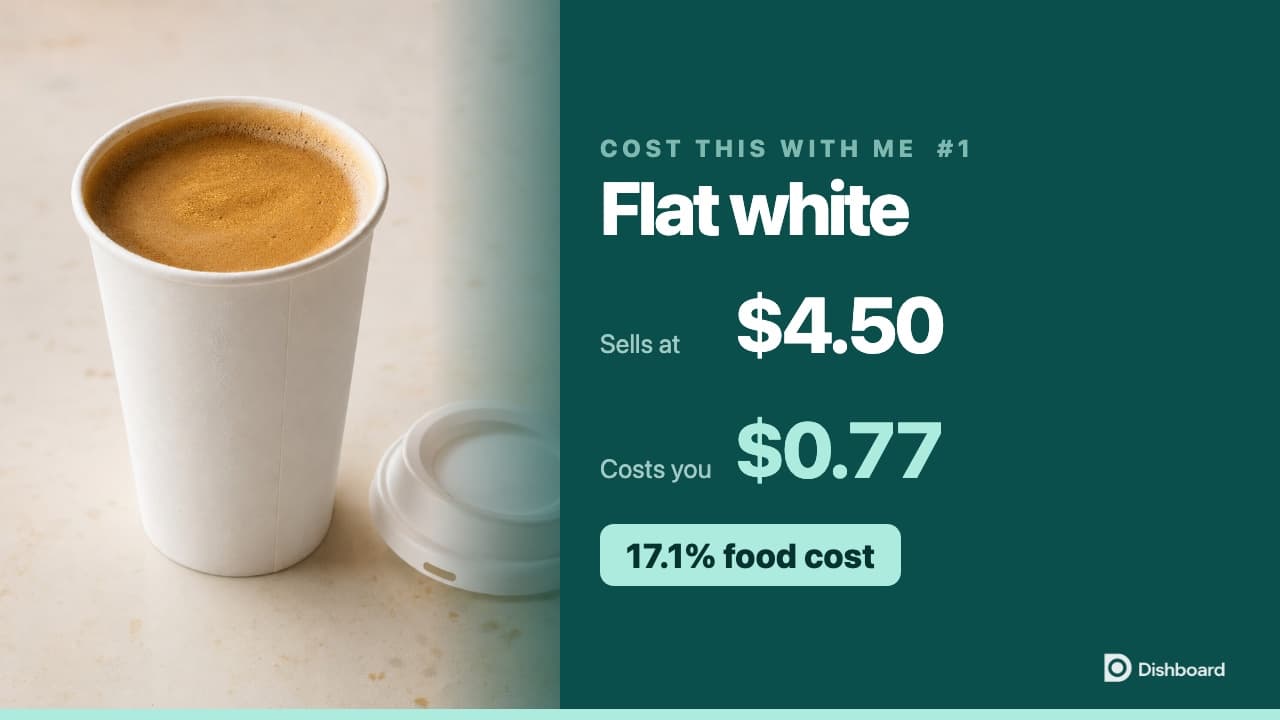
Flat white, $4.50 on the board, 60 seconds to make. So what does it actually cost you? Let's do it properly, line by line.
Three things go in. 18 grams of beans. You buy those at $26 a kilo, so that shot is $0.47. 120 mils of whole milk at $1.35 a liter, $0.16. And the cup, lid, and sleeve, $0.14. Yes, the cup counts. It leaves with the drink.
Add it up, $0.77 against $4.50, that is a 17.1% food cost, and $3.73 of gross profit on every single one.
Is that good? For espresso drinks, you're aiming somewhere between 18% and 25%, so yes, comfortably. But here is the part that actually matters. That chicken sandwich we costed makes $6.61. So not even two coffees match it. The sandwich needs a kitchen, a chef, and 10 minutes. The coffee needs one. That is why the coffee pays the rent.
Cost yours the same way. It's free, no card, dishboard.co. And if you want more of these, subscribe.
Enter your beans, milk, cup and selling price, and see the pour cost.
Free, and no account needed.
Free tools
Put the math to work in seconds. No signup required.