
How to calculate delivery menu margins
Delivery profit is not the same as dine-in profit. Platform commission, packaging, payment fees, and discounts all reduce what you keep from each order.
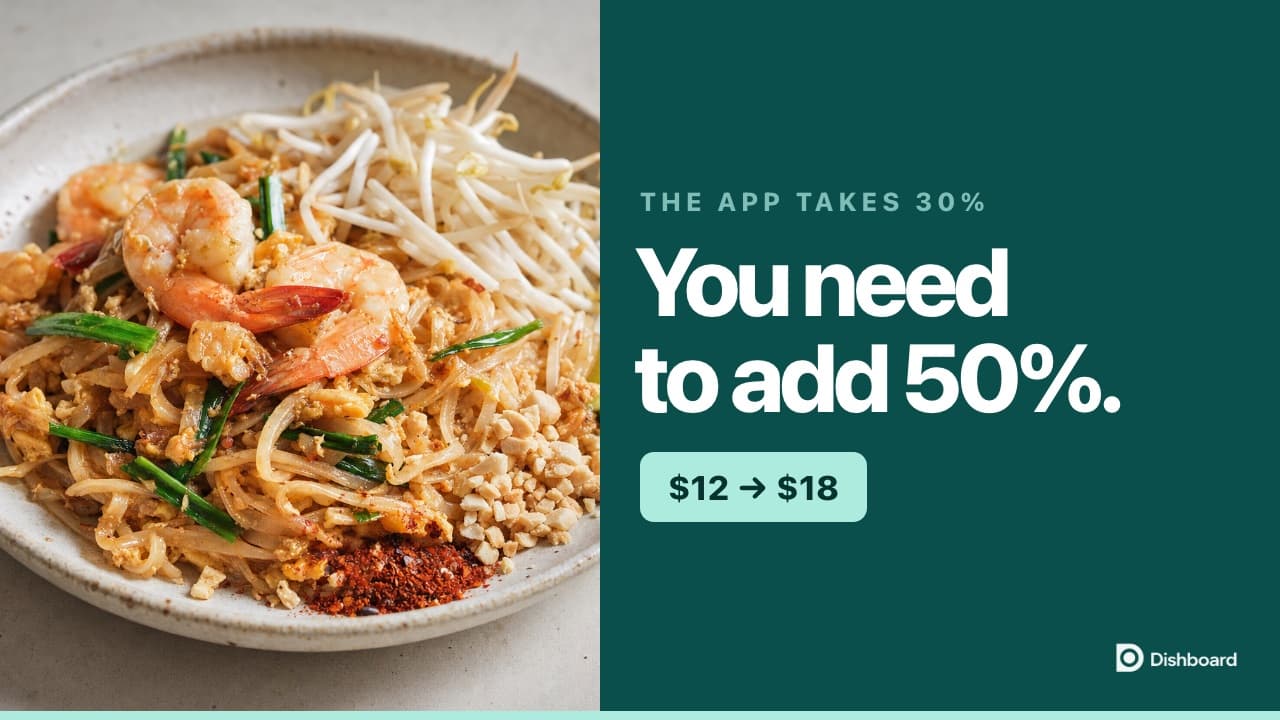
A menu item that is profitable dine-in can be underwater on delivery. The food cost percentage is the same either way. What changes is how much of the selling price you actually keep after the platform takes its cut.
Understanding delivery margin is not optional if you sell on DoorDash, Uber Eats, or Grubhub. It is how you decide which dishes to push on delivery, what delivery prices to set, and whether a platform is worth keeping at all.
The full delivery margin formula
Delivery profit = selling price minus recipe cost minus packaging minus platform commission minus payment fees minus discounts and promotions
Each of these elements deserves a number, not a guess.
A full worked example
A rice bowl sells for $14.00 on delivery. Here is the full breakdown:
Delivery profit: $14.00 minus $3.80 minus $0.85 minus $3.50 minus $0.35 minus $1.40 = $4.10
Delivery margin: $4.10 divided by $14.00 = 29.3%
The same rice bowl dine-in at $12.00 with no packaging or commission earns $12.00 minus $3.80 = $8.20 gross profit, twice as much per sale.
Platform commission rates
Commission rates vary by platform and contract tier. Approximate US ranges:
Always use your actual contract rate. Published ranges are starting points, not what you are paying.
Packaging costs add up
Delivery packaging (insulated bags, sealed containers, side containers, utensils) costs meaningfully more than dine-in serviceware. A full delivery order with soup, a main, a drink, and condiments can carry $1.50 to $2.50 in packaging alone.
If you are not measuring packaging cost per order, you are likely underestimating your delivery cost by $1 to $2 per transaction.
Should delivery prices be higher than dine-in?
Yes, in most cases. Delivery customers are not surprised by delivery prices being 10 to 20% higher than dine-in. The platform UI makes the comparison harder and consumers accept a convenience premium.
A common approach: set delivery prices to recover the commission, so your gross profit per delivery order is similar to dine-in. If commission is 25%, a dine-in price of $12.00 would need a delivery price of roughly $16.00 to maintain the same gross profit (ignoring packaging).
How to decide if a platform is worth keeping
Calculate average delivery margin across your top 10 selling items on each platform. If the margin is consistently below 20%, the platform is consuming your profit. At that point you have three options: raise delivery prices, remove low-margin items from the delivery menu, or renegotiate your commission rate.
Platforms will sometimes negotiate, especially if your order volume is meaningful or if you threaten to leave.
Frequently asked questions
Read the transcript
An app takes 30% of the order. That is the top tier on both of the big ones. So you add 30% to your delivery prices, and you are square again, right? You are not. And the gap is bigger than almost anyone expects.
Here is a pad thai. $12 on your menu. The food in it costs $3.90. So dine in, you keep $8.10. Hold on to that number, because everything from here is about whether delivery gets you back to it.
First, listed on the app at the same $12. The app takes 30%, which is $3.60. You keep $8.40. Out of that comes the food, $3.90, and the packaging, $0.60. Your profit is $3.90. You were making $8.10. Same dish, same price, less than half the money.
So put the price up. 30% on $12 is $15.60. But now the app takes 30% of $15.60, which is $4.68. Not $3.60. That is the part people miss. The commission comes off the new price too. You keep $10.92, and after food and packaging, your profit is $6.42. Better. Still $1.68 short of dine in.
To actually get back to $8.10, the price is $18. That is 50% up, not 30. Because you do not multiply by what they take. You divide by what you keep. They take 30%, so you keep 70. Your costs, plus the profit you want, divided by 70%. That is $18.
And that is the real answer, $18 for a pad thai on an app. Some kitchens can charge that, most cannot, which makes this a listing decision, not a pricing one. The dishes that work on delivery are the ones with room in them, and it is usually not the cheap one you are proudest of.
So before you put your menu on an app, cost it per channel. Dine in, takeaway, delivery, with the commission and the packaging in. Some dishes will be fine, some will be a lot worse than you think. You can do that free at dishboard.co. No card. And if this was useful, subscribe.
Add the commission, the packaging and the fees, and see the profit per order.
Free, and no account needed.
Free tools
Put the math to work in seconds. No signup required.